
This morning on my phone, I watched an orangutan in a destroyed forest attack a bulldozer, while two other primates tried to stop him. There was a third primate in the bulldozer, and I wonder if it was scared, looking through the metal and plastic of the cabin out at this enraged great ape with long arms. The scene looked like it smelled of petrichor and wood shavings, and probably the ripe smell of orange fur, sweat, and panic from two different but related animals. I’ve never been comfortable watching orangutans or gorillas at zoos. Through the green branches, even from a safe distance, you could see their eyes and facial expressions. Who are these tall, hairless creatures who eat chocolate spread in toast and pastries and who need extra smooth peanut butter? Why am I here, and why are they staring at me? I want to go home. Where is my home?
Author: Mel Gutierrez
Roy
My dad passed away yesterday morning. I have a lot of feelings about it. I’ve asked for pictures of him and for his cologne, so I could remember him as he was. My dad was a flawed man, but he was kind to me. He was funny, and I never knew anyone else who could tell a story like he could. He rolled high in charisma before he entered the world in 1946. He grew up during the 50s and 60s, and that was the music we would listen to in his red truck on the way home after he’d picked me up from school. We usually stopped by a little corner store to pick up a Mars bar or a Klondike ice cream. His favorite candy was Smarties, and when I was still trick or treating, I saved those for him. When I was a child, we bonded over animal documentaries and McDonalds. I have a lot of learned bad habits from him, but I wish I had picked up his ease when talking to strangers. He was in the army and went to Vietnam, where his body began to be destroyed. The destruction continued when he broke his ankle as a cop in East LA. After that, he became a bus driver for the Montebello School District, where he made many friends who liked to give me candy and coins. He worked there for many years before he retired, and retirement was ok at first.
He never learned to make financially sound decisions. He was an impulsive spender and a compulsive eater. Part of the reason he left the earth three decades early was his own decision. It was hard for him to move, and he didn’t like cooking. So, he stayed on the couch and watched TV, interspersed with visits to the local fast food joints. He lost a lot of friends as he grew older. A lot of them didn’t like his new wife, and I don’t know much about the social politics there, because it was none of my business. But he was lonely. I lived far, and so did his brother. And then I moved even farther.
Maybe I could’ve been more involved. Maybe I could’ve done more. But as an adult, he could make his own choices, and he put himself under the care of his new wife. In many ways, that was a relief. My parents had me when they were older. These kinds of decisions should be reserved for people in their 40s and 50s, whose uncertainty has been mostly peeled away by time and fatigue. I’m only in my 30s, and in my 20s, I was mostly concerned about navigating college and finding a job with three liberal arts degrees. It’s not an excuse, but it is a reason. I expected my adult dad to make adult decisions about his own life, and as his child, that’s a fully reasonable thing to expect.
There’s a reason, several reasons, I will never have children. I know myself, and I know my capabilities. I am a selfish creature. I am human. How can I possibly subject an innocent child to my own psychological damages? I am, however, lucky enough to be able to make that call. Thirty years ago, it was the expectation. While things are changing now, it’s still considered normal to want children of your own.
There’s a strange remnant of old-school thought that children owe their parents something—love, care, respect. If children are lucky, they do get parents they can love and respect. But it’s never been harder for children to care for older adults. We don’t get big houses anymore. It’s too expensive. Even reasonably sized apartments are too costly to afford, even with roommates, and there’s something profoundly unpleasant about being forced to live in close quarters with your parents. Some parents are great, but that doesn’t mean you don’t need your own space eventually. So, if you can’t afford the space, can you afford anything else? People fear being sent to homes because they have a reputation. You go to live in a building with strangers where strangers take care of you. You lose your independence, and without that what’s the point of existing? Nice ones are more expensive than people expect. Even ratholes you wouldn’t send your worst enemy to are ridiculously priced. So as the child of an older adult that needs care, you’re caught between your own individuality and that of your parents, the people who brought you into this world without your consent. None of us asked to be here, as far as I know. We arrive screaming into this horror show and are expected to be grateful. Life is a trainwreck with beautiful scenery.
My dad wasn’t perfect, and he knew it. He was manipulative and stubborn and ignorant. He was one of the people who expected God to do all the work. But he loved me. And I loved him. And I will miss him. I’ll miss our brief calls discussing the weather in our respective climes. I’ll miss his crass jokes. I’ll miss his banter with my Uncle Rick in diners whose waitresses loved him. I’ll miss ordering a too-large strawberry Belgian waffle and passing the rest to him so he could enjoy it.
But there are things I’ve been missing for a while. I miss being a child. I miss thinking my dad was the smartest person in the world, who could draw cool planes and drive really well. I miss feeling safe. One of the strangest feelings in the world is growing up enough to see your parents objectively as people, flawed people, who don’t know much more about the world than you do.
I hope wherever he is, he’s happy. I’m unsure if my dad had ever been happy in life. Judging by how he lived, I wouldn’t imagine he was, but again, we never quite know our parents.
Discussing Fanfiction – A Cento
Spock receives a mystery card, thinks it’s from Kirk, but it’s not.
This is exactly the way it should have happened:
Jim and Spock get wasted and Jim discovers spontaneous bonding,
which precipitates an unintended cultural exchange.
This is exactly the way it should have happened:
Spock must bond with Jim in order to save his life,
which precipitates an unintended cultural exchange—
Spock thought no one was looking.
Spock must bond with Jim in order to save his life,
an incident during a disastrous shore leave when
Spock thought no one was looking.
Some things are inevitable.
Spock receives a mystery card, thinks it’s from Kirk, but it’s not.
The last thing Jim wants is telepathic proof that Spock hates him—
some things are inevitable—
and Chekov never means to eavesdrop.
Marble
The other day, I went to the doctor because I couldn’t
get warm. I would rub my fingers together, cricket fast,
rub my hands against my cold jeans, hug the heater,
put on jackets, don several scarves, and wear a hat. I tried
gloves. I exercised,
mostly.
I watched TV, saw what they planned for the wolf
cubs in their dens, imagined tall
white men with bombs crunching away from the helicopter.
I boiled, still frozen.
The appointment was for next
month, and while I waited, I drew shapes
into the frozen condensation on my arms. I chilled
beers with my hands, stood close to friends at hot ball games,
went to the desert and paved my way
through the wavy lines with my stiff limbs.
With his gloved hand, he took my pulse, recommended
rest, and told me to make another appointment
if I didn’t get better.
I left and settled
into an alcove in a park,
surrounded by shrubs and passing
squirrels, and I became her,
the marble statue in the garden.
Look how patiently
she seems to stare
away, as if waiting.
Oasis
But really though, the convent
didn’t prepare me for this—
for the beautiful drag queens lip syncing on stage,
the stamps on my skin, on my oven burn,
the heat of a crowd warmed from the inside out
by LA water, cosmos, exotic drinks with rum
that spin the room like the music
that slides against the walls,
against posters on the walls
of men with bigger breasts, and lovelier faces, and joy
so palpable I’m proud of strangers
in the crowd and on the stage, all here
for the change in rhythm I give,
because why keep the status quo?
New shapes, copies of infinity,
hips and unfamiliar hands,
feathers and beads and air—
fresh in the parking lot,
the blood cooling in our veins,
and I begin to concern myself
with the driver, who’s had a couple,
and the insufficient material of my jacket.
Daedalus
Dear diary,
last week, I made a cow
for the queen, wooden,
hollow, so she could meet the white bull
in the corral, at midnight. Dear
diary, it’s been nine months. She’s asked me to turn
the splintered shell into a crib.
I recarved it, a cradle for the large
shape under her dress. Dear diary,
two years since I made the cradle,
the king has ordered I use it
to construct a sign. The Labyrinth, he said,
an enormous maze, at the center a little,
hungry toddler with flat teeth, one who looks
at us sideways.
Dear diary, seven years since
the king locked my secrets in the tower.
My son is growing
taller. It’s time. The window is large
and our wings rest on mannequins
against the wall. Tomorrow we fly
away, a new life.
Cobra
Around that time, prom was only two weeks away, or so. A butter yellow dress hung in the closet. Thailand felt heavy, a wet that settled on our skins and hair. The Songkran painted our bus with super soakers, smiles through running window streams, people in the streets, colors and splashes of balloons. We rode elephants and fed them tiny bananas; they grabbed them with polite, no-nonsense trunks. Please, don’t touch. Please, don’t sit on the crocodiles. The man stared down the long, black danger-noodle, and they danced. The man kissed the noodle on the head like I’d kiss my small cat before bed. He passed the live cobra around. Look at this dark silk rope—here, touch. At home, you were waiting to call me again and cry into the phone with dry eyes. It felt smooth, a flawless dry surface with hypodermic fangs that could kill. Once bitten, the venom affects a person’s nervous system, causing severe pain, vertigo, blurred vision, paralysis. People slip into comas, stop breathing. I was the first to touch it.
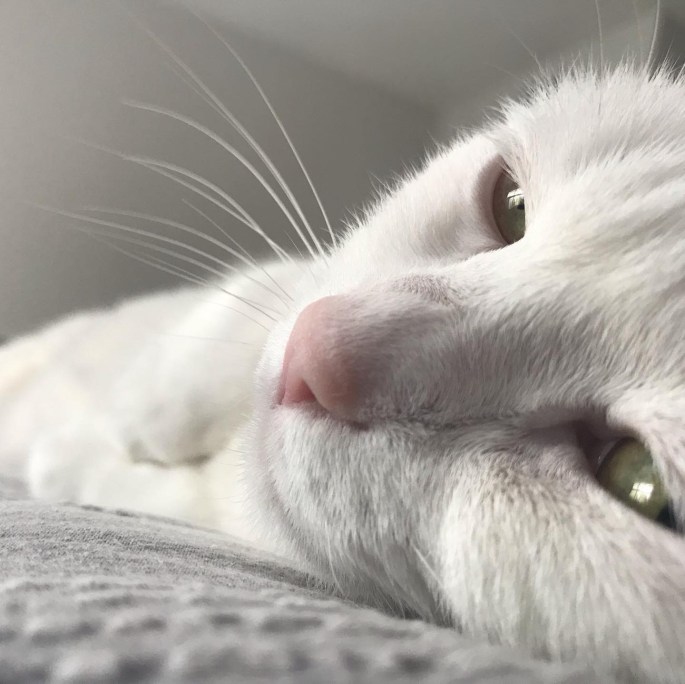
My Cat Has breast cancer. Yes, it’s a thing.
We found a lump, right on her belly near one of her nipples. It was concerning, because we’d never felt it there before, and that’s usually a sign of rapid cell growth. We went to the vet, who took a needle aspiration biopsy that turned out to have abnormal cells. The next step was removing the lump, which turned out to be a lump with a small lump beside it. The pathologist diagnosed it as a stage 3, malignant type of cancer, and, using the only study of its kind, gave my cat 8 months to live.
Goblin is a white cat with striking yellow eyes. When we rescued her, her name had been Snow White. As soon as she opened her mouth and meowed, we knew she was a Goblin, not a princess corpse. Her meow sounds like an old crabby grandmother complaining to her children about how much her ankles hurt.
Her original vet told us she could be anywhere from 4 to 9 years old. The vet also told us she was spayed. She wasn’t.
One of the best ways to prevent breast cancer in the mammary ducts of most cats is to get them spayed as early as possible. By the time we got her, it was too late.
Goblin has a perpetually worried face, which, now, is finally warranted.
We have a scan scheduled for two weeks from now, which will tell us if any of her other organs have been affected by the cancer. My partner and I have discussed it. If there is evidence of cancer in the other organs, we’re going to let her live out the rest of her life as comfortably as possible and love her until she goes.
If there isn’t evidence of cancer spread, I’m not sure what to do. We could pursue surgery. The first and foremost treatment for feline breast cancer is a bilateral mastectomy, which, unfortunately, has to be two different surgeries. Goblin has a heart condition, which means any time we put her under could be dangerous.
Goblin’s favorite pill pocket flavor is chicken, and she’ll turn up her nose at every other flavor.
The oncologist sent us a study that indicates even with surgery she still has barely more than 8 months left. This cancer is virulent and merciless. But what if she’s the statistical anomaly?
Goblin’s head sometimes smells like vanilla, and she has the softest fur. Her favorite game is when I slide hair ties down the banister so she can catch them in her paws.
I try not to think about it too much. The same feeling of rage and helplessness I felt before my own mastectomy decision is present, but now it comes with a sense of abject fear. I can gamble with my life, make decisions that impact my health with full understanding, but how can I make the same gamble with her life? She’s a cat, but she’s a person with whom I have limited communication and with whom I’ve shared a life.
Goblin has a meow that sounds like she’s saying hello. She has another that sounds like she’s saying wow.
I’ve cried over the situation, spent a day grieving the loss that hasn’t happened yet. I’m no closer to finding a solution that feels fair. I know life isn’t fair.
If I could have the surgery for her, bear the pain of surgery and recovery, take on the risk, I’d do it in a tiny heartbeat. She might know that.
We’ve lived with her for six years, and no matter how many more we’ll get it will never be enough. Her presence is a joy, and she shares her warmth with anyone who sits still long enough for her to climb onto their lap.
New Boobs. Who Dis?
I’m 31, not really an age when one considers receiving brand new body parts. It’s not like I’ve lived 80 years on a slowly deteriorating hip and needed a brand new robot bone. However, considering my history with cancer started more than a decade earlier, it really shouldn’t have come as a surprise.
When I was 20, my best friend, Joanna, and I were headed down to Los Angeles from Davis, CA, on our winter break from college. We were listening to Jim Dale reading Harry Potter and the Deathly Hallows, when we passed Pyramid Lake. I pointed it out Joanna, blinked, and was being pulled out of CT scanner by a nurse in scrubs. Somewhere between the lake and Los Angeles, we had been driven off the freeway and down a large embankment, where Joanna’s Saturn landed upside down.
I don’t remember any of this. Later, when Joanna and I were reunited out of the hospital, she described how she helped me unbuckle my seatbelt and pulled me out of the wrecked blue car. Some kind strangers had stopped to help us, and she and they pulled me back up to the side of the freeway, where an ambulance waited for us. Joanna’s knee had been shattered. In the ambulance, I would ask her where we were and what had happened every five minutes.
In the CT scanner, they found a concussion, a spot on my thyroid, and a spot on my lungs. Later, I learned I had a mass behind my thyroid about 9mm in diameter that likely wouldn’t have been discovered otherwise until it was much more dangerous.
By this time, I think at least two of my aunts had died of pancreatic cancer.
At 20, I was tasked by the doctor to determine for myself whether I wanted to try keeping half of my thyroid. In some cases, it was possible for a thyroid to recover completely even with half the organ in place, although I might still need to take pills every day to make up for any hormonal deficits. It was also entirely possible the cancer might be present on the half I kept. Considering there was no guarantee keeping half of my organ would actually work, I opted for the logical conclusion–taking it out.
I don’t remember much about the surgery or the recovery apart from asking for anything other than morphine. Morphine, as it turns out, turns me into a crying lunatic. And following the surgery, I had two rounds of radioactive iodine two years in a row. That was the worst.
Once my third aunt was diagnosed with pancreatic cancer, I knew we had a family problem. It was genetic, and I was determined to do my best to avoid it. I asked my doctor what I could do to prevent pancreatic cancer if it was a genetic anomaly in my family; she connected me to a medical professional I’d never heard of–a genetic councilor.
I was born with the BRCA 2 gene mutation, a flaw in one of my genes that makes it statistically more likely that I will get breast cancer, ovarian cancer, pancreatic cancer, and, in some cases, colon cancer.
Breast cancer: develops in women by age 70-80 in 45%-69% of those with the gene
Ovarian cancer: develops in women by age 70-80 in 11% – 17% of those with the gene
Pancreatic cancer: lifetime risk is around 5%-10% of those with the gene
Cancer.GOV
ASCO Publications
As soon as I learned of the existence of this gene in my body, I had more decisions to make. As a BRCA 2 carrier, my choices in avoiding breast cancer are either prophylactic double mastectomy or yearly surveillance of my breast tissue every year until I developed breast cancer or died in some other way.
I did try surveillance. I got my first mammogram at age 29, and it was pretty awful. I also got a breast MRI, which was worse.
Prophylactic surgery, logically, was the wisest course of action. Some days I was completely certain about my decision and some days I questioned my own sanity. Assuming I lived until closer to 100, I will have lived without my breasts longer than with them.
They were also a great source of pleasure to me. Sexually, they were an integral part of who I was and what I enjoyed. By doing this I would be sacrificing decades of sexual pleasure for the near certainty of never getting cancer, at least there. Luckily for me, they weren’t my only source of satisfaction, and one of them still remains sensitive.
Before I made my decision, I did hours of research. I talked to other women who had the surgery and asked them about their experience. I joined forums and Facebook groups. I read books and websites. I asked my doctors hundreds of questions.
On the day of the surgery, I still doubted whether I was doing the right thing. Today, I’m still not sure, although I don’t regret it.
Despite the emotional rollercoaster of making the decision to scrape all my breast tissue out of my body, I was lucky enough to have an insurance company that would also pay for reconstruction. I went from an A cup I was never happy with to a C cup that looks amazing.
I’ve never been more happy with the way my proportions look, and my surgeon did an excellent job at hiding the scars in the underboob. My breasts were always a source of frustration for me, and, as I found out later, they were actually malformed in the womb. The insides of my breasts were so scarred that there was room enough for the full silicone implants–which meant I didn’t need to come back for a second surgery.
Occasionally, I forget I had the surgery. My implants feel as normal to me as my old breasts did, though my left one is still numb in the middle, so I won’t notice if it pops out from under my bra. It’s a cheeky little bastard.
Every so often, I’ll remember what I’ve done, and I’ll feel weird about it. I can’t believe I did that. As volatile as the decision made me feel, it’s been two years since I had natural breasts, and I don’t miss them as much as I thought I would. I am lucky. Considering all the horror stories I’ve heard, I’m so lucky.
I’m 31. Twice, I’ve had to deliberately remove pieces of myself to make my body safer. In another nine years, I will be doing it again with my ovaries. By 50, who knows what else will go.
LA Café
The line’s grown long
again. I’ve counted six pairs
of black, work shoes.
Every person has nice
shoes. For some reason
people insist on sweatshirts.
I’d like a Sunday hat,
to wear to church, though I
don’t go to church.
Perhaps the church should advertise
hats, as a selling point.
Being unfreckled, I wish freckles
were my problem. Two paper
cups across a table might say
to each other, I know
what it’s like to be empty, too.
The noise is constant, several
conversations congregate in the recesses
of the room like a flock of reed-voiced
birds discussing politics,
cynically. Interviewers have taken
over an entire half
of a café. At some point I’ll stop
staring at the pastries behind glass,
glazed as if freshly made,
rather than a day-old remainder.
The line has gotten longer.
A girl’s shirt reads
Game on, but I don’t
know what she means exactly.
Pre-gaming implies one needs
inebriation to enjoy padded
body jousting. What do you
say to the man with two
llamas fucking on his shirt?
Uncle Sam is on a button
on the man’s backpack and he’s angry
about the man’s wardrobe selection.
What Not to Wear—
founding father edition.
Sir, your ideals don’t
match your party colors.
Never pair flippancy with neoliberalism.
He should try a cooler palette.
 Melcontents